Family: Amaranthaceae
Common name: Joseph’s coat, Parrot leaf, Fig joyweed, Copperleaf, Calico plant, Bloodleaf
Joseph’s coat is a plant that originated in South America, but is now extremely common in other parts of the world. In India, they are seen very commonly on hillsides, roadsides, parks, unoccupied land and along with other cultivation.
Plant characteristics
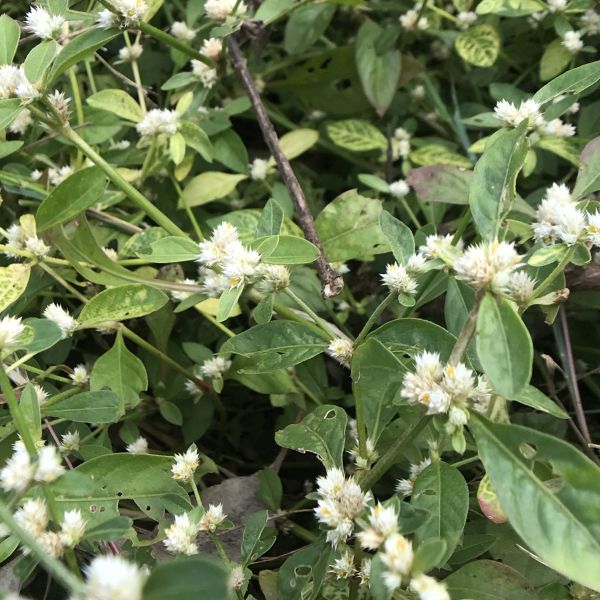
Joseph’s coat grows horizontally along the ground with thin long stems that can be 60-90 cm long. The stem is hairy and can produce roots along the nodes enabling it to spread rapidly.
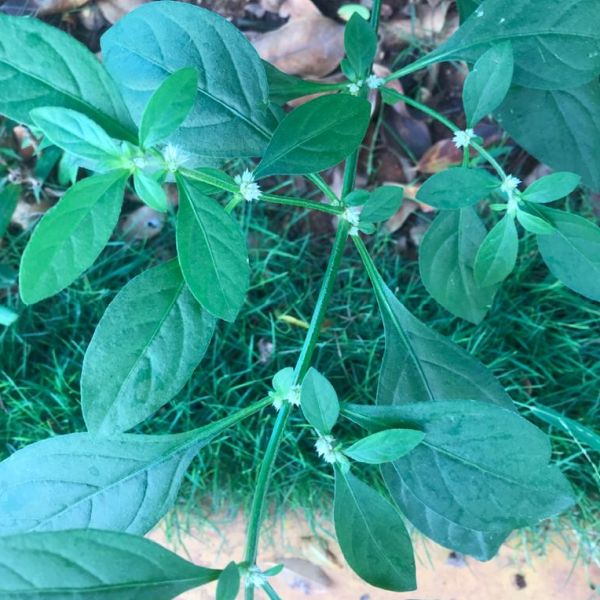
Joseph’s coat leaves are small, opposite, elongated oval and sometimes has thin hairs covering the surface. They are 4-6 cm long and 3-4 cm wide.
They are characterized by their tufts of white flowers that grow on all the nodes of the plant, covering the ground with white blooms. These tiny flowers are only 3-5 mm in diameter, produced in abundance during spring.
After blooming, they produce tiny seeds that turn brown when they mature and fall from the plant.
Growing tips
Joseph’s coat plants can grow in almost all types of soil – sandy, rocky, loamy, water-logged, even by the edges of ponds.
They grow in full sun or partial shade of the trees, tolerant of water logging, heavy rains, and poor soil conditions.
They are considered invasive weeds in agricultural land, and can be removed by hand-plucking or tilling. They are difficult to remove since small pieces of stem left on the ground can produce roots and create more plants.
Uses of Joseph’s coat
These unassuming weeds have many medicinal and culinary uses. In South India, the leaves, stems and flowers are consumed as vegetable cooked like spinach leaves.
In herbal medicine, these plants are used in the respiratory ailments since they have anti-inflammatory and antiseptic properties.
Propagation
Propagation is from seeds and stem cuttings, since the plant roots easily at the nodes.
Photographed at: Koonammavu, Kerala