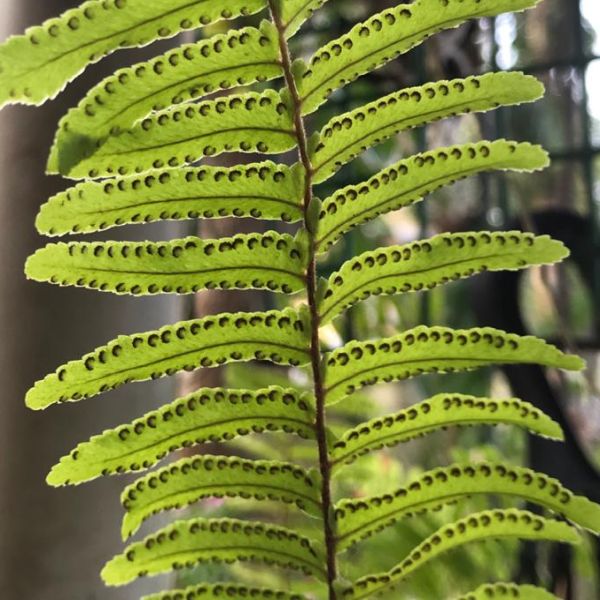
Family: Nephrolepidaceae
Common name: Fishbone fern, Narrow sword fern, Ladder fern, Tuber ladder fern, Tuberous sword fern, Herringbone fern, Erect sword fern
A beautiful bushy fern commonly seen in gardens, Fishbone ferns are very hardy and require very little maintenance.
Plant Characteristics
They can grow to a height of of 60-80 cm with beautifully radiating leaves having narrow leaflets or pinnae. Roots of the Fishbone fern are shallow with thick rhizomes that run parallel to the ground. Long fronds arise from the rhizomes.
The fronds have deep brown stalk or rachis, which contrasts well with the long, green leaves. These leaves are about 20-40 cm long with pairs of alternately arranged leaflets, which are 4-6 cm long.
They have irregular margins and rounded tips. Fishbone fern leaves are bright green when they grow in the shade, and yellowish green in bright sunlight.
Reproduction in Fishbone ferns is through spores contained in sori, dark round spots on the underside of the leaflets. These sori are clearly visible in mature leaves, but are covered with protective tissue in younger leaves.
Fishbone ferns produce tubers underground, which is also a method of propagation. A very closely related species called Boston fern or Nephrolepis exaltata does not produce root tubers.
Gardening Tips
They are easy to grow and care for, in living rooms, indoor spaces, and shaded areas of your gardens. They love moisture and should be watered well regularly.
Misting also helps maintain the freshness and color of the lovely fronds. They do not need direct sunlight, but they cannot survive in dark corners either.
It’s better to place the Fishbone ferns near well-lit windows that get some indirect sunlight.
The capability of ferns to reproduce using multiple failsafe methods, and spread quickly over large areas make them an invasive weed, especially in woodland areas in certain parts of the world.
They can be removed by hand plucking them from the soil, but spores would remain in the soil, producing a fresh batch of ferns in no time.
Fishbone ferns can replace native plants in forests, shrublands, open areas, isolated urban spaces, and forest edges.
Uses of Fishbone Fern
Fishbone ferns are excellent ornamental plants that can be grown in flowerbeds, pots, or hanging baskets. They look lovely in hanging baskets, their long, trailing fronds draping over the edge of the basket very gracefully.
In spite of their invasive nature, they are favorites among gardeners because of their versatility, and sturdy nature. Fishbone ferns can also be grown near waterbodies like koi ponds where they bring a tropical vibe to the place.
Propagation
A mature Fishbone fern produces thousands of spores, which are dispersed by wind or water. When these spores land on viable surfaces, they germinate into baby ferns.
Fishbone ferns can also reproduce vegetatively through underground stems called rhizomes or through small tubers.
When grown in large pots having enough space, ferns will produce small plants around them through the trailing underground stems.
Photographed at: Thrissur, Kerala