Family: Lamiaceae
Common name: Indian borage, Country borage, Mexican mint, Cuban oregano, Plectranthus amboinicus, Country borage, French thyme, Soup mint, Broad leaf thyme, Spanish thyme, Panikoorkka, Karpooravalli, Patharchur, Dodda pathre
A very common plant in Indian gardens, Indian borage is now losing its place to fancier ornamental plants. It is a succulent with a distinct odor and taste, and the leaves of this plant have been used for medicinal purposes.
Plant Characteristics
Indian borage plants grow to a height of 80-100 cm, covering the pot beautifully with long stems draping over the edges of the pot. The stem is succulent and green, capable of rooting very quickly, making the plants very easy to propagate.
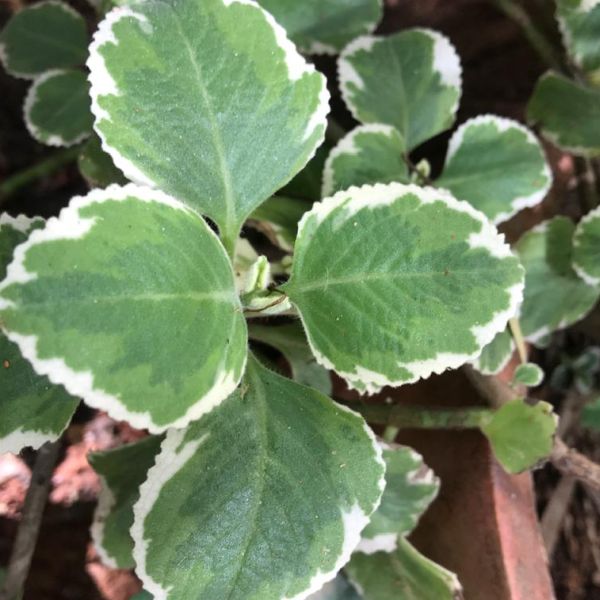
The leaves are fleshy and rounded with toothed edges, about 6-8 cms long. They are covered with hair, especially on the lower surface.
Indian borage leaves have a distinct fragrance when crushed, or even when they move around while watering. This is due to the presence of essential oils like carvacrol and thymol.
There is another variant available with variegated leaves, having a white outline around the edge of the leaves. This one is not as popular as the plain green-leaved variety.
Indian borage plants produce small purple flowers that look very similar to those of Tulsi, in bunches of 10-20 on long racemes. Flowering usually happens in warm, summer months, attracting various pollinators like bees, birds, butterflies, and insects to them.
Pollinated flowers produce small brown nutlets, but these are not very commonly produced in house plants.
Gardening Tips
Indian borage plants need bright sunlight to grow and flower well, but the leaves might burn with harsh, direct sunlight. They thrive in tropical weather with high humidity and rainfall.
Regular watering is needed, but the frequency of watering should be determined based on how soon the soil dries out. Overwatering can cause root rot since the plant stems are succulent in nature.
Fertilize once in 2-3 weeks with compost or other organic fertilizers. Pruning can be done to trim any extra-long branches, keeping the plants short and bushy.
Leaves are likely to be eaten by pests and worms, and hence you need to do regular neem oil spraying to deter them.
Uses of Indian Borage
Leaves of the Indian borage are eaten raw and also used in cooking as potherbs. They have a strong aroma and flavor with a spicy heat.
Leaves are used for making herbal tea, which is soothing for cough and chest congestion. Indian borage leaves are used in traditional herbal medicine in the treatment of indigestion, bloating, diarrhea, cough, fever, cold, bronchitis, asthma, urinary diseases, headache, inflammations, cuts, wounds, ulcers, conjunctivitis, insect bites, and more.
In short, Indian borage was highly valued and grow in every household as a remedy for common ailments. Juice extracted from the leaves can be given to children and adults to treat fever and cough. Steam inhalation with hot water, infused with these leaves, helps clear nasal and throat congestion.
A medicinal plant yet to be glorified to its rightful place, Indian Borage has been long considered panacea for a variety of ailments.
Propagation
Propagation is through stem cuttings, with very high success rate.
A small piece of stem with a root noded can be planted in moist soil to take root in a few days. They grow very quickly, covering the pot in couple of months.
Photographed at: Sobha Petunia, Bangalore, GKVK University of Agriculture, Bangalore