
Family: Solanaceae
Common name: Petunia
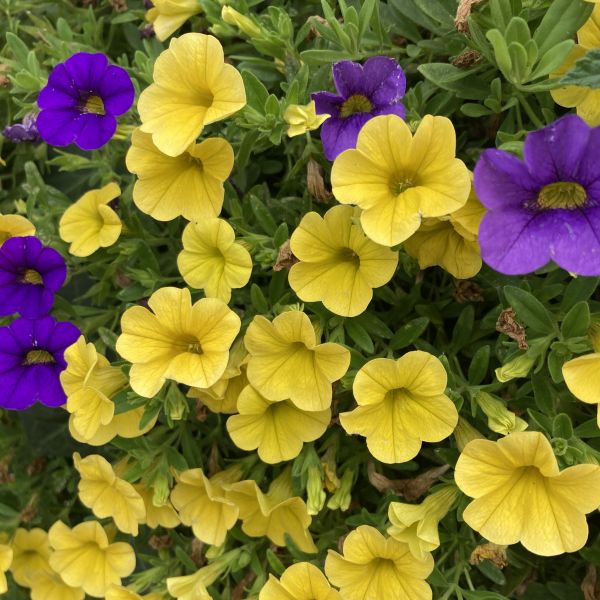
It’s difficult to find flowers with more colors, color combinations, and exuberance than Petunia flowers for your garden. They come in a wide variety of colors from white, yellow, pink, orange, red, magenta, purple, even black; and all kinds of combinations of these colors.
Plant characteristics
Petunia plants usually grow to a height of 1 meter, blooming profusely in summer.
The root system of Petunia is fibrous spreading only on the top few centimeters of the soil, and hence they need regular watering.
The stem is soft and green, covered with small white hairs. They branch well to keep the plant rounded and bushy. Some varieties of petunias are compact and bushy, with upright stems, while others have trailing or cascading that are ideal for hanging baskets or pots.
Leaves of Petunia plants are broad, oval-shaped, about 8-10 cm long. They are bright green and almost succulent, wilting very quickly when there is no regular watering.
Flowers are definitely the highlight of this plant, with tubular flowers coming in a wide range of colors, sizes, and patterns.
In addition to the dizzying range of solid-colored flowers, there are Petunia flowers with white patterns along the edges, radiating along the center of the petals, or even speckled all over the petals.
There are 4 common types of Petunia, depending on the size of the flowers:
Grandiflora Petunias have flowers that are 3-4 inches in diameter. Multiflora Petunias have smaller flowers, but they bloom more abundantly. Milliflora Petunia flowers are even smaller at about 1 inch in diameter. And Spreading or Wave Petunias grow horizontally and fill a pot in no time.
Wave Petunias are further sub-divided into Easy wave, Shock wave and Avalanche petunias, depending on how much they spread or hang.
Petunias also have the most brilliantly named cultivars like Carpet series, Heavenly lavender, Sugar daddy, Rose star, Celebrity, Madness and many more.
Common garden Petunias do not produce fruits or seeds.
Gardening tips
All species need excellent sunlight to promote blooming. They also need regular pruning and fertilization to prevent the plant from becoming scraggly.
They are reasonably drought-tolerant and can do without water for a couple of days. But make sure you water them regularly during the summer months when the plants can wilt in no time.
At the same time, over-watering or water logging can lead to root and stem rot. In short, these plants are not for the lazy or forgetful gardener:)
Deadheading must done to remove spent or wilted flowers, to keep the plant pretty. Petunia plants are annuals, growing and blooming for a single season before they die.
Uses of Petunia
They are mostly grown as ornamental plants in flower beds, hanging pots, or as border plants.
Petunia plants can be grown as ground cover to protect the topsoil. However, since the plants are short-lived, they do not have a lasting effect.
Propagation
Propagation is from stem cuttings or seeds.
Since house plants do not produce seeds or fruits, this method is not very commonly used. Stem cuttings also do not take root easily. Hence most gardeners buy Petunia during season from nurseries.
Photographed at: Toronto, Canada; Nagavara, Bangalore; St. John’s church, Kolkata


