

Family: Rubiaceae
Common name: Tropical girdlepod, Whiteeye, Thaval
A plant very commonly seen in the wild in India, Tropical girdlepods have multiple levels of leaves and flowers.
Plant characteristics
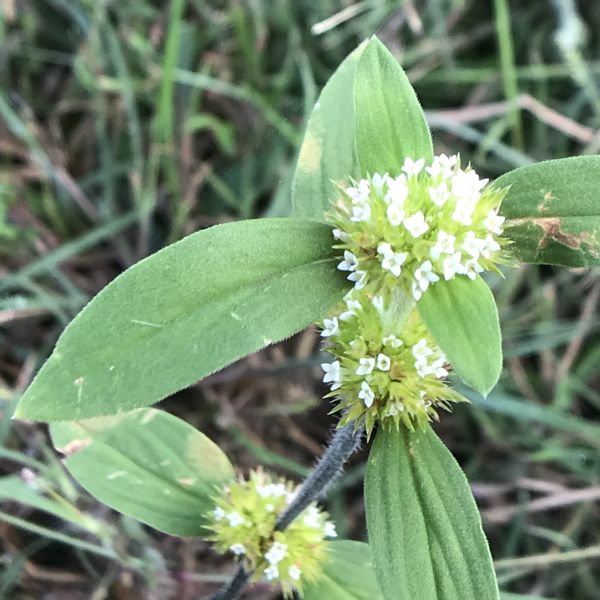
Tropical girdlepod plants are erect with thin green stems covered with velvety hairs. Leaves grow perpendicular to the stem from the nodes, 5-10 leaves at each node.
Small white flowers grow in bunches from the axils of the leaves, the angle between the leaves at the stem. The leaves and flowers at different nodes give the plant a very interesting look, with white pom-poms all along the stem.
Because of the height of the stem, and the weight of flowers at each node, the stems are quite weak and can bend down or slant to the ground with just the tip pointing upwards.
With some support from other plants and trees around, Tropical girdlepod plants can grow to a height of about 1 foot with branching stems.
Leaves are lance-like and long with a single prominent dent at the mid-vein and almost no other venation. Flower bunches can grow to a diameter of 5-7 mm with over 10 tiny sepals and flowers arranged very close to each other. They have a small corolla tube and four distinct petals fused at the base.
Topical girdlepod flowers have prominent anthers and stamens; and are usually pollinated by insects and ants. The flowers then produce tiny fruits that are about 1 mm long containing brown-colored seeds.
Growing tips
They are common weeds on hillsides, grasslands, and unoccupied areas in India, though urbanization is now threatening the survival of this beautiful plant.
Tropical girdlepods are considered invasive weeds in agricultural land. They are relatively easy to remove by handplucking. Make sure they are removed before the plant produces seeds, since they can self-seed and produce multiple small plants.
Tropical girdlepods prefer good sunlight and well-draining soil though they can grow in partial shade, poor soil conditions, and temporary waterlogging.
Uses of Tropical girdlepods
Though these plants are considered invasive weeds, they have some medicinal uses in the treatment of ulcers, eczema, cuts, wounds, burns, leprosy, liver diseases, rashes, toothache, jaundice, hepatitis, and so on.
It is important to exercise extreme caution while using herbal medicines and they should not be used without expert advice.
Propagation
Propagation is through seeds.
Photographed at: Koonammavu, Kerala




How do I harvest for medicinal uses?
Hi,
Thank you for reaching out. I have no expertise in herbal medicine, and so I do not want to give advice on how to use the Tropical girdlepod for medicinal purposes. I can direct you to websites that give more information. With a warning that you should exercise extreme caution while doing self-medication of any kind. It is essential to get expert advise.
https://www.socfindoconservation.co.id/plant/313?lang=en#:~:text=In%20ethnomedicine%2C%20Mitracarpus%20species%20offer,%2C%20jaundice%2C%20rashes%2C%20ringworm%2C
https://www.researchgate.net/publication/345320034_ANTIBACTERIAL_ACTIVITIES_PHYTOCHEMICAL_SCREENING_AND_CHROMATOGRAPHIC_STUDIES_OF_MITRACARPUS_SCABER_GIRDLEPOD_LEAF_EXTRACTS
Sorry I could not help more.
Regards
Nancy