

Family: Lamiaceae
Common name: Thumba, Thumbapoovu, Thumbai, Common Leucas, Dronapushpi, Tamba, Chiruthumba, Tumbe geeda
A very pretty little plant commonly seen in the wild, it is also listed under the name Leucas Zeylanica. Thumba plants are native to South Asia, and are seen all over India, especially in southern India.
Plant Characteristics
These plants grow to a height of 1.3 feet with small crowns of white flowers. Roots are shallow and fibrous, spread out to collect water from the soil.
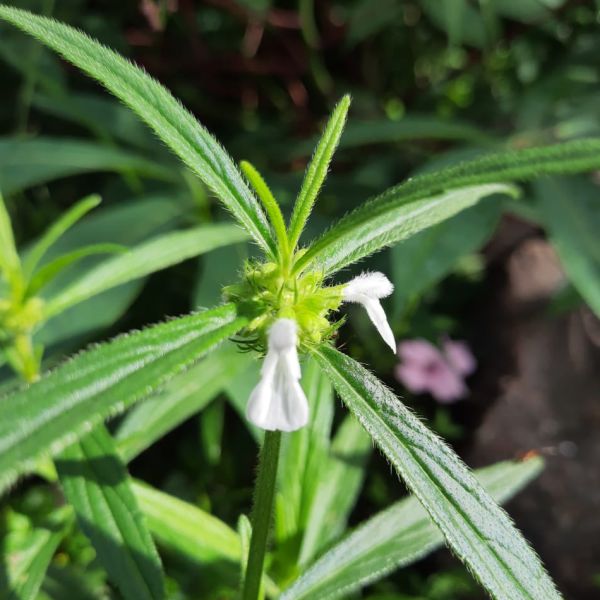
The stem is quadrangular or squarish in cross-section, green, well-branched, and hairy.
Leaves of the Thumba plant are narrow and lance-shaped with no petiole or a very short petiole, which is the stalk that attaches the leaves to the stem.
These leaves are 8-12 cm long with a slightly hairy surface and serrated edges. They have a distinct fragrance when crushed, suggesting the presence of some essential oils that give them a specific scent.
Flowers are very distinctive, small, white, and pretty with a unique shape. They are held in umbrella-like whorls that are produced at the nodes of the plant.
They have a lower lip and upper lip, the lower lip fanned out like a petal, and the upper lip almost curled up into a small ball. Thumba flowers are tubular at the base, about 1-2 cm long.
Flowering happens during summer and spring, a relatively long period when the plant is covered with beautiful, pristine white flowers.
They have a special significance in the Onam festival, the harvest festival of the Southernmost state, Kerala. Children go around the yard plucking these flowers to make flower carpets or pookalams for Onam.
After pollination, the Thumba plant produces small nutlets that are about 1-2 mm long, containing seeds.
Growing Tips
Thumba plants are very sturdy, growing in backyards, empty plots, roadsides, and even in between small cracks in the pavement. But now, these plants are disappearing due to the urbanization of areas.
They need good sunlight for most part of the day, but they can also grow in the partial shade of large trees. Being wild plants, they are tolerant of poor soil conditions, and even some amount of water logging.
Thumba plants mostly spring up during the rainy season and hence they do not need watering or care. They are annuals that grow, flower, produce fruits, and then die by peak summer, the seeds stored in the soil till the next rains.
Uses of Thumba Plants
Thuma plants have been used in Ayurveda, Siddha and traditional herbal medicine in the treatment of fever, worms, respiratory illnesses, sores, wounds, gastric issues, skin diseases; and even for snake and scorpion bites. They were considered essential plants to have in the garden or backyard.
The leaves were used in cooking. They are used as insecticides due to their anti-fungal and anti-microbial properties.
Propagation
Propagation is through seeds.
Mature seeds collected from the parent plant can be dried and sown in moist, well-draining soil to germinate in 8-10 days, after which the small plantlets can be replanted to avoid overcrowding.
Photographed at: Koonmmavu, Kerala



Are there different variety thumba, some not used for Onam flower decoration?
To the best of my understanding, thumbapoo is what we call Leucas aspera. And that is used for Onam flower decorations or pookkalam. Please send me pictures of other thumba, and I would love to include that information the website.